
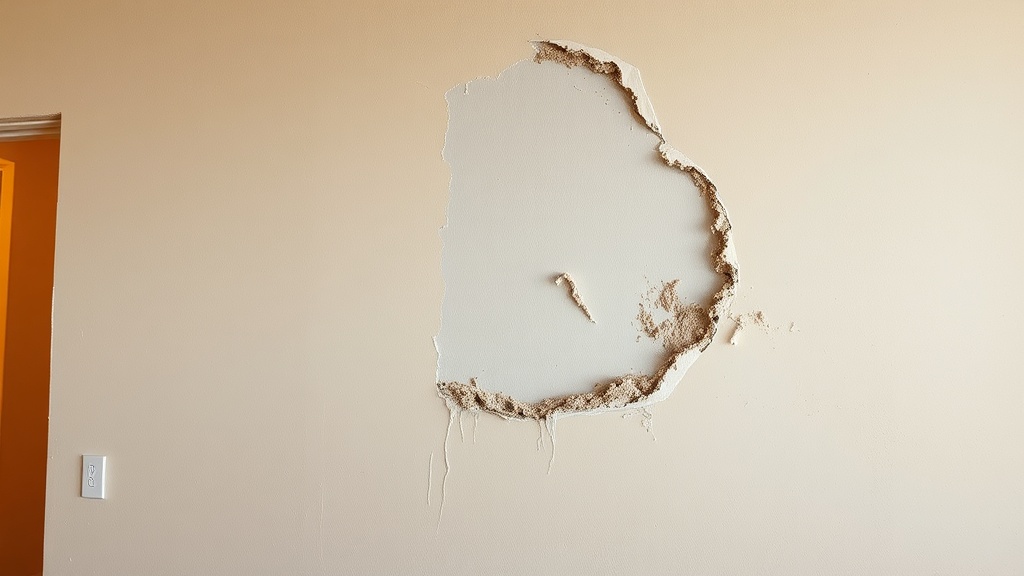
We appreciate the DIY spirit. We really do. But we also spend a meaningful part of our week fixing repairs that a homeowner started and couldn't finish — or finished wrong. The most expensive jobs aren't the original problems. They're the secondary damage caused by an incomplete or incorrect repair.
This isn't a lecture. It's practical advice from a crew that has seen what happens when the wrong approach is taken on common Yuma home repairs.
Mistake 1 — Painting Over a Surface That Wasn't Properly Prepped
In Yuma's desert climate, the failure mode for exterior paint is almost always prep, not paint quality. Homeowners buy quality paint, roll it on a dirty or chalky surface, and wonder why it's peeling six months later.
What prep actually requires:
- Power wash or hand wash the surface and let it dry completely (in Yuma, 24 hours is usually enough)
- Scrape any loose, flaking, or chalking paint down to a firm surface
- Sand transitions between old paint and bare surface so the new coat doesn't build up a visible edge
- Fill any cracks with appropriate caulk — elastomeric for stucco and masonry, paintable acrylic for wood
- Apply the correct primer for the substrate — this step is skipped more than any other
Skipping prep saves 20% of the time and costs you 70% of the paint life.
Mistake 2 — Caulking Over Old Caulk
When caulk cracks or pulls away, the instinct is to lay a new bead on top. The problem is that new caulk doesn't bond well to old caulk — it bonds to the surfaces on either side. Caulking on top of caulk creates a thicker, stiffer joint that's more likely to crack again in the same spot.
The right way: Remove the old caulk completely with a caulk remover tool or utility knife, clean the joint, let it dry, then apply fresh caulk. Takes longer, lasts years longer.
Mistake 3 — Using the Wrong Type of Anchor for Drywall
Not all wall anchors are equal, and the wrong anchor for the weight or substrate can fail catastrophically. In Yuma, this comes up especially with:
- Grab bars: Must go into studs — period. Toggle bolts in drywall alone cannot hold the dynamic load of a person bracing themselves from a fall.
- TV mounts: Must go into studs or use heavy-duty toggle anchors rated for the weight of the TV plus the mount.
- Shelf brackets: Each bracket should hit at least one stud whenever possible.
- Curtain rods in concrete block walls: Common in Yuma homes. Requires masonry anchors — drywall anchors won't hold in block.
Mistake 4 — Turning Off the Wrong Breaker
Before any electrical work — even something as simple as replacing an outlet — confirm the correct circuit is de-energized with a non-contact voltage tester ($20 at any hardware store). Circuit breakers are not always labeled accurately, especially in older Yuma homes where additions or rewiring happened over the decades.
Never assume a circuit is off based only on the breaker position. Test first. Always.
Mistake 5 — Running a Drain Snake Too Aggressively
A clogged drain is a common homeowner job. But running a manual snake the wrong way can damage plastic drain pipes or push a clog deeper rather than breaking it up. In Yuma's older homes (especially Foothills properties from the 1980s), pipes may be ABS plastic that can crack if a snake is forced through a tight junction.
For slow drains, try enzyme drain cleaner first (overnight, repeat twice). For complete blockages, a snake is appropriate — use it gently and rotate as you advance. If you're hitting resistance that doesn't clear in a few inches, the blockage may be beyond DIY territory.
Mistake 6 — Patching Drywall Without Backing
Small holes (under 3") can be patched with mesh tape and compound. Anything larger needs something to attach to. Homeowners often try to span larger holes with mesh alone — this results in a patch that sags and cracks as soon as the compound dries.
For holes larger than a fist, cut the hole into a clean rectangle, install wood backing on both sides that extends beyond the cut edges, and fasten a patch panel to the backing. Tape and mud from there. This is the repair that actually holds.
Mistake 7 — Skipping the Shutoff Valve Before Plumbing Work
This one costs homeowners real money. The shutoff valve for your kitchen faucet might be under the sink. The angle stop might be seized from years without use. The main shutoff might not fully close because of sediment in Yuma's hard water.
Before any plumbing work, test your shutoffs in a non-emergency situation. Know where your main water shutoff is. If an angle stop under the sink won't close fully, replace it now — not at midnight when you're mid-repair with water running.
When to Call a Professional
Not every home repair is worth doing yourself. Here's a simple test:
- If you're not confident in the result, the professional repair will be cheaper than fixing the DIY repair
- If the job requires pulling a permit (structural work, major electrical, full HVAC), a licensed contractor is required by Arizona law
- If the repair involves safety equipment (grab bars, handrails, smoke detectors), the stakes of a failure are too high for guesswork
- If you've already started and aren't sure what you're looking at, stopping and calling is always cheaper than going further in the wrong direction
For the repairs that are beyond your comfort level, Handyman Yuma AZ is available at (877) 385-8386. Written quotes, licensed, insured — no judgment about whatever state the project is in when we arrive.